Plastic Seed Tray Size Guide: Choose the Right Cell Size for Your Plant
Choosing the right seed tray size depends on plant type, root development, and seedling age.
✅ 32–50 cells: Best for large, fast-growing crops (melons, cucumbers).
✅ 72 cells: Ideal for tomatoes, peppers, and many vegetables.
✅ 105–128 cells: Typical choice for leafy greens and herbs.
✅ 200+ cells: Suitable for small seeds and high-density production (lettuce, onions).
Use the chart below to quickly find the best seed tray size for popular crops.
👉 Swipe the table left/right to view all size details.
| Plant Type | Recommended Cell Count | Cell Size |
|---|
| Tomato | 50 / 72 / 128 | Medium |
| Pepper | 72 / 105 | Medium |
| Lettuce | 128 / 200 / 288 | Small |
| Cucumber | 32 / 50 / 72 | Large |
| Onion | 200 / 288 | Small |
| Basil | 72 / 105 / 128 | Medium |
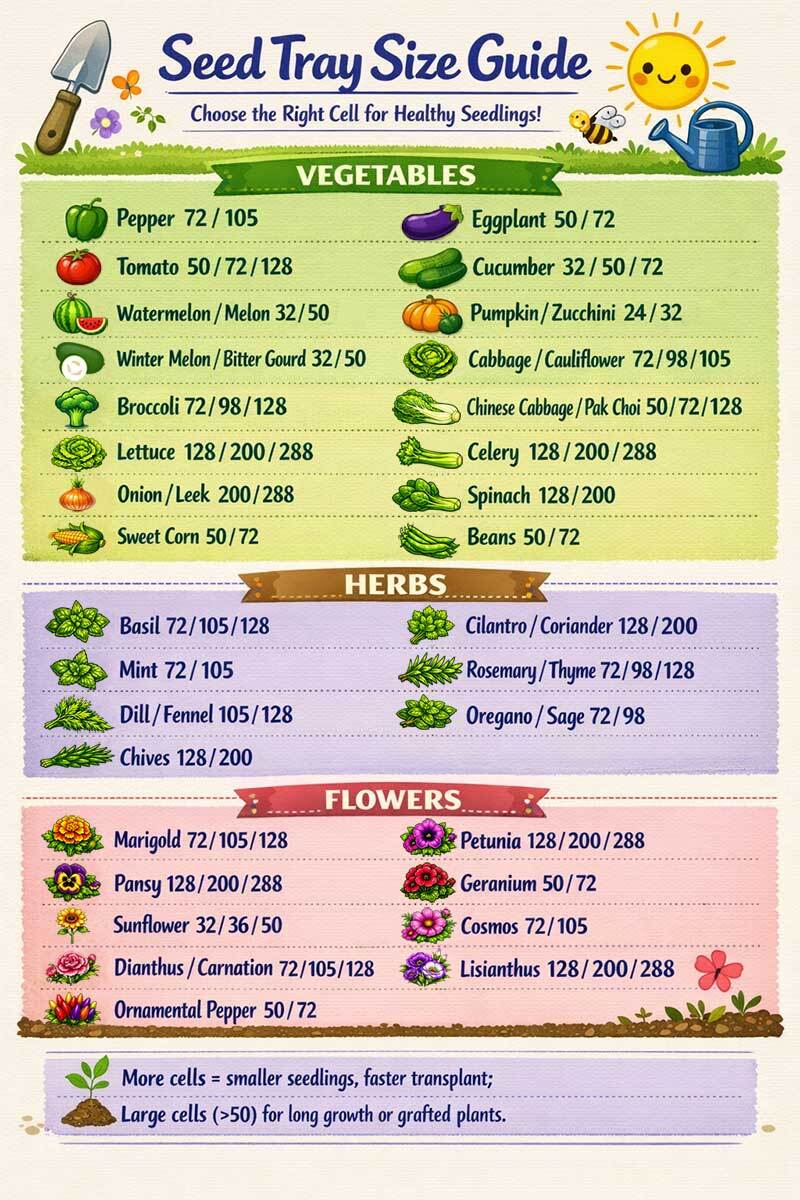
Different plants require different cell sizes. Use this quick guide to choose the right seed tray for vegetables, herbs, and flowers.
👉 Need more information about seed trays? Read our Seed Tray Complete Guide.
Core Selection Logic (How to Choose Tray Size)
Large Cell Trays (24–50 cells)
Best for: melons, cucumbers, pumpkins, and grafted seedlings.
Features: strong root development. longer seedling age.
Medium Cell Trays (50–128 cells)
Best for: tomatoes, peppers, and eggplants.
72-cell trays are the most widely used option for commercial vegetable production.
Small Cell Trays (128–288 cells)
Best for: lettuce, onions, herbs, and flowers.
Features: high density. space saving. requires timely transplanting.
What Size Seed Tray for Each Plant
What Size Seed Tray for Tomatoes
✅ Recommended: 50–72 cell trays.
Early production → 50 cells.
Standard production → 72 cells.
High-density → 128 cells.
What Size Seed Tray for Peppers
✅ Recommended: 72–105 cells.
What Size Seed Tray for Lettuce
✅ Recommended: 128–200 cells.
What Size Tray for Cucumbers
✅ Recommended: 32–50 cells.
Detailed Seed Tray Size Recommendations
Vegetable Seed Tray Size Guide
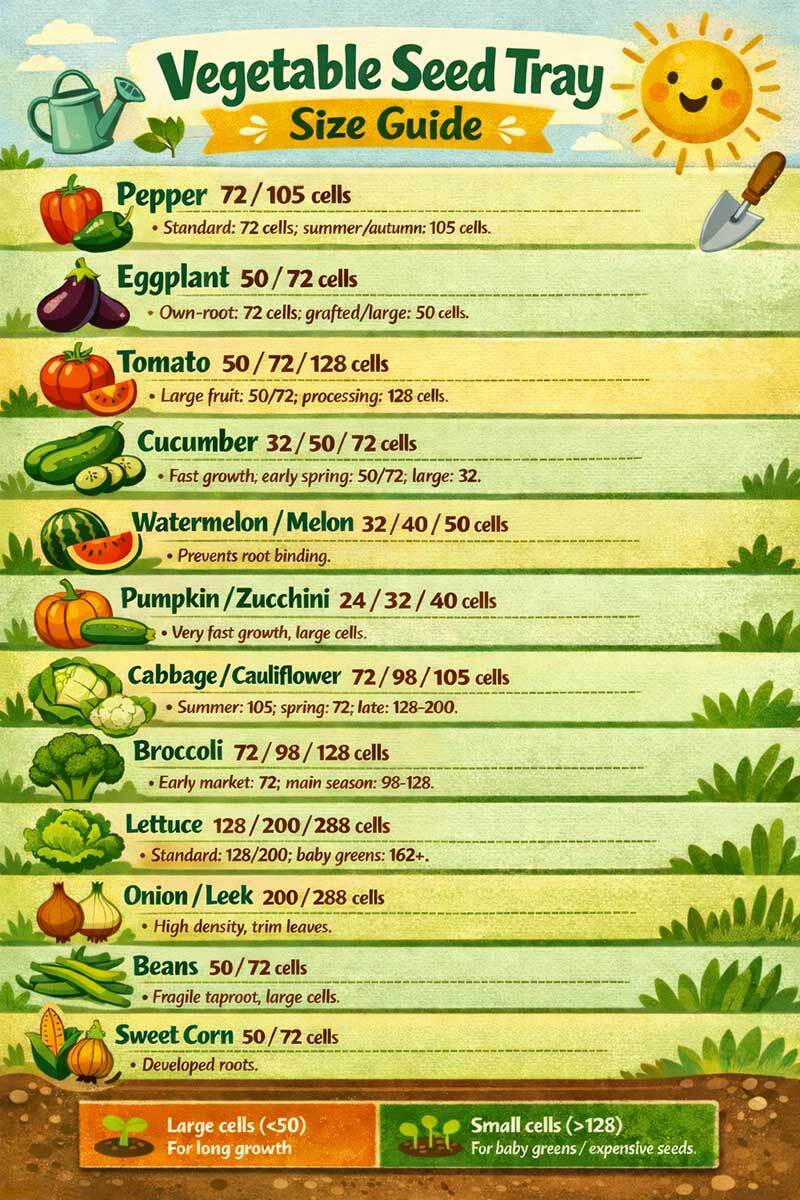
Most fruiting vegetables (tomatoes, peppers, eggplants) perform best in 50–72 cell trays. Leafy greens prefer higher-density trays.
👉 Swipe the table left/right to view all size details.
| Plant Type | Recommended Cell Count | Notes |
|---|
| Pepper | 72 / 105 | Standard cultivation uses 72 cells. If seedlings with less than 6 leaves are needed or for summer/autumn production, you can use 105 or even 128 cells. |
| Eggplant | 50 / 72 | Standard own-root seedlings use 72 cells. For grafted seedlings or large seedlings (6–7 leaves), 50 cells are recommended, or even 32 cells for higher early yield. |
| Tomato | 50 / 72 / 128 | Large-fruited or early cultivation uses 50/72 cells. Scion seedlings or mid-late cultivation can use 128 cells. Processing tomatoes may even use 288 cells. |
| Cucumber | 32 / 50 / 72 | Cucurbits have fast root growth, large cells recommended. Early spring cultivation uses 50 or 72 cells. For longer seedling age or large seedlings, use 32 cells. |
| Watermelon / Melon | 32 / 50 | Similar to cucumber, need larger space to prevent root binding. Early cultivation mostly uses 32–50 cells. |
| Pumpkin / Zucchini | 24 / 32 | Very fast growth, recommend using the largest cells (24–38 cells), seedling age 3–4 weeks before transplanting. |
| Winter Melon / Bitter Gourd | 32 / 50 | Longer seedling age, need larger root space, recommend 32–50 cells. |
| Cabbage / Cauliflower | 72 / 98 / 105 | Summer/autumn production can use 105 cells. Early spring or large seedlings use 72 cells. Late season cultivation can use 128–200 cells. |
| Broccoli | 72 / 98 / 128 | Same as cabbage family. Early market uses 72 cells, main season production uses 98–128 cells. |
| Chinese Cabbage / Pak Choi | 50 / 72 / 128 | For large Chinese cabbage seedlings (30 days) for disease resistance, use 50 cells. For ordinary Pak Choi or "baby" production, cruciferous vegetables can use 72 cells. |
| Lettuce | 128 / 200 / 288 | Standardized commercial seedlings mostly use 128 or 200 cells. For producing "baby" leaves, asteraceae varieties recommend 162 or larger cells to improve quality. |
| Celery | 128 / 200 / 288 | Celery seeds are tiny, slow initial growth. Suitable for high-density production (128–288 cells), seedling age 50–80 days. |
| Onion / Leek | 200 / 288 | Onion production usually very high density, commonly 200–288 cells. Need multiple leaf trimmings to control height. |
| Spinach | 128 / 200 | Although spinach is often direct-seeded, transplanting seedlings can use 128–200 cells. |
| Sweet Corn | 50 / 72 | Sweet corn has developed roots, recommend single sowing in 50 or 72 cells. |
| Beans (Cowpea / Green Bean) | 50 / 72 | Beans have strong taproots; they do not tolerate transplanting. If using plug trays, choose large cells (50–72) and keep seedling age small. |
Herb Seed Tray Size Guide
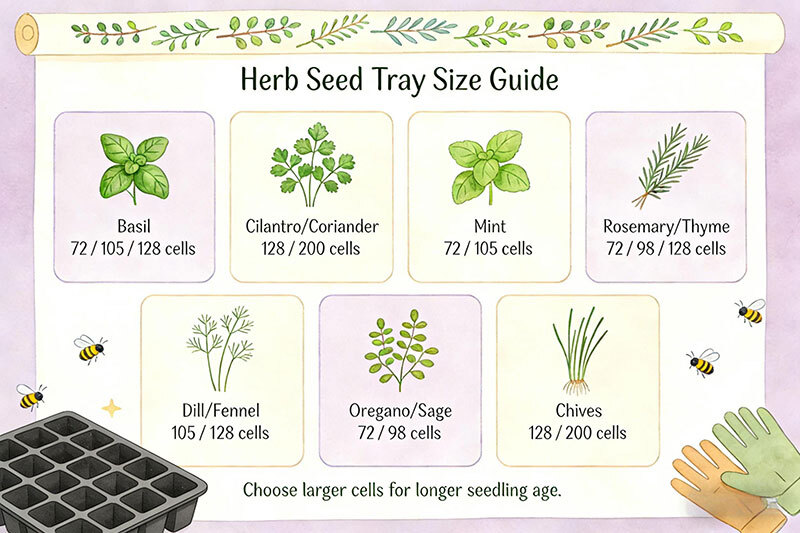
Most herbs grow well in 72–128 cell trays. They balance root development and production efficiency. High-density trays (128–200 cells) are often used for small or slow-growing herbs. For example, chives and cilantro.
👉 Swipe the table left/right to view all size details.
| Plant Type | Recommended Cell Count | Notes |
|---|
| Basil | 72 / 105 / 128 | Moderate growth rate. 72 cells for larger seedlings, 128 cells for standard commercial seedlings. |
| Cilantro / Coriander | 128 / 200 | Taproot, but seedlings are small. You can use 128–200 cells, transplant promptly. |
| Mint | 72 / 105 | Fast growth and developed roots. I recommend 72 or 105 cells. |
| Rosemary / Thyme | 72 / 98 / 128 | Woody herbs grow slowly. But for root development, commonly use 72–128 cells. |
| Dill / Fennel | 105 / 128 | Taproot, recommend slightly larger cells (105–128) and transplant as early as possible. |
| Oregano / Sage | 72 / 98 | Recommend 72–98 cells to favor perennial root system development. |
| Chives | 128 / 200 | Alliums usually use small cells for high-density production. |
Flower Seed Tray Size Guide
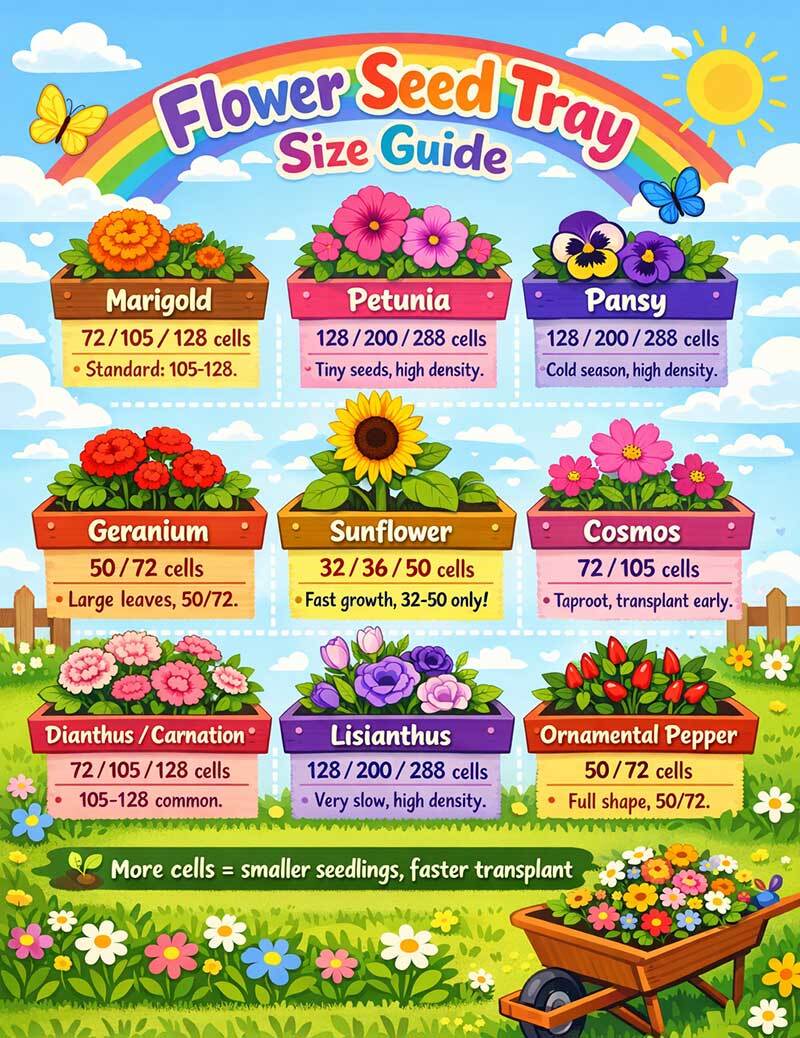
Most flowers are grown in 72–128 cell trays for balanced growth. Small-seed or slow-growing varieties (such as petunia and pansy) are typically started in high-density trays (128–288 cells).
👉 Swipe the table left/right to view all size details.
| Plant Type | Recommended Cell Count | Notes |
|---|
| Marigold / French Marigold | 72 / 105 / 128 | Common annual/biennial flowers. For standard potted seedlings, commonly use 105–128 cells. |
| Petunia | 128 / 200 / 288 | Tiny seeds, initially suited for high-density production in 288 or 200 cells. Then pot up before transplanting. |
| Pansy / Viola | 128 / 200 / 288 | Similar to petunia, high-density cells commonly used in cold season production. |
| Geranium | 50 / 72 | Geranium seedlings grow fast with large leaves. They need large cells (50–72) to avoid crowding. |
| Cockscomb | 72 / 105 | Moderate growth rate, 72–105 cells are acceptable. |
| Sunflower | 32 / 40 / 50 | Cut flower sunflowers grow extremely fast. Must use large cells (32–50), otherwise roots quickly fill the cell. |
| Cosmos | 72 / 105 | Taproot, use 72 or 105 cells, transplant as early as possible. |
| Scarlet Sage | 72 / 105 / 128 | Commonly use 105–128 cells. |
| Ornamental Pepper / Ornamental Eggplant | 50 / 72 | Similar to vegetables, for full plant shape, commonly use 50 or 72 cells. |
| Dianthus / Carnation | 72 / 105 / 128 | Commonly use 105–128 cells. |
| Lisianthus | 128 / 200 / 288 | Tiny seeds, extremely slow seedling growth. They often raised in high-density cells (288 cells) for a long time. |
How to Choose Seed Trays for Commercial Growing
Production scale
✅ Large-scale → 128+ cells.
✅ Premium crops → 50–72 cells.
Labor & mechanization
✅ Machine transplanting → 72–128 cells.
Cost efficiency
✅ Higher density = lower cost per plant.
✅ Larger cells = higher survival rate.
Frequently Asked Questions
Q: What is the best seed tray size for beginners?
A: A 72-cell seed tray is the best choice for beginners. It offers a good balance between root space and plant density. Suitable for most vegetables like tomatoes and peppers.
Q: Are larger cells better for seedlings?
A: Not always. Larger cells support stronger root growth and longer seedling periods. But smaller cells are more efficient for fast-growing or high-density crops. For example, lettuce.
Q: Can I reuse plastic seed trays?
A: Yes, you can reuse most plastic seed trays multiple times. Choose durable trays and clean them after each use. This prevents disease and extends their lifespan.
From Seed to Harvest: Choosing the Right Containers
Starting with the right seed tray is only the first step. As your plants grow, container selection at each stage becomes essential for healthy development and maximum yield.
Seed Starting: Choose the right cell size based on your crop.
👉 Explore Plastic Seed Trays.
Transplant Stage: Provide more root space for continued growth.
👉 See Plastic Nursery Pot Size Guide.
Final Growing: Use larger containers for full plant development.
👉 Check Fabric Grow Bag Size Guide.