What to Grow in 10 Gallon Grow Bags: Best Plants Guide
Introduction
10 gallon grow bags are one of the most popular container sizes for growing vegetables, herbs, and compact fruiting plants. In this guide, you’ll learn what you can grow in a 10 gallon grow bag. We also provide practical spacing and yield expectations.
Why Choose 10 Gallon Grow Bags?
Compared to smaller containers, 10 gallon grow bags offer:
✔️ Enough root space for medium to large crops.
✔️ Better moisture retention than smaller containers.
✔️ Excellent drainage and airflow for healthier roots.
✔️ Air pruning helps prevent root circling.
✔️ Easy to move and reposition.
✔️ Suitable for patios, balconies, greenhouses, and backyard gardens.
They are ideal for growers who want higher yields without committing to large raised beds.
What Can You Grow in 10 Gallon Grow Bags?
Fruiting Vegetables (Top Performers)
These are the best crops for maximizing yield in a single bag.
✅ Tomatoes (determinate or compact indeterminate varieties).
✅ Peppers (bell, chili, jalapeño).
✅ Eggplant.
✅ Compact zucchini varieties.
These plants thrive in 10 gallon fabric pots. They provide enough depth for strong root systems.
10 gallon grow bags are commonly used for:
✔️ Patio vegetable gardens.
✔️ Balcony gardening.
✔️ Greenhouse tomato production.
✔️ Intensive container gardening.
Recommended Planting Density:
✅ Tomatoes: 1 plant per bag.
✅ Peppers: 2–3 plants per bag.
✅ Eggplant: 1 plant per bag.
✅ Zucchini: 1 compact plant per bag.
Growing Tips:
✔️ Use cages or stakes for tomatoes and peppers.
✔️ Place bags in full sun for maximum fruit production.
✔️ Feed regularly during flowering and fruiting stages.
✔️ Avoid overcrowding to maintain airflow and reduce disease pressure.
Root Vegetables
Loose potting soil improves root shape and reduces soil compaction.
✅ Potatoes.
✅ Carrots.
✅ Beets.
✅ Radishes.
The breathable fabric sides help maintain healthier root conditions.
Recommended Planting Density:
✔️ Potatoes: 3–5 seed potatoes per bag.
✔️ Carrots: 20–30 plants per bag.
✔️ Beets: 6–8 plants per bag.
✔️ Radishes: 15–20 plants per bag.
Growing Tips:
✅ Use lightweight, well-draining potting mix.
✅ Keep soil consistently moist during root development.
✅ Hill potatoes gradually as plants grow.
✅ Avoid compacted garden soil for better root expansion.
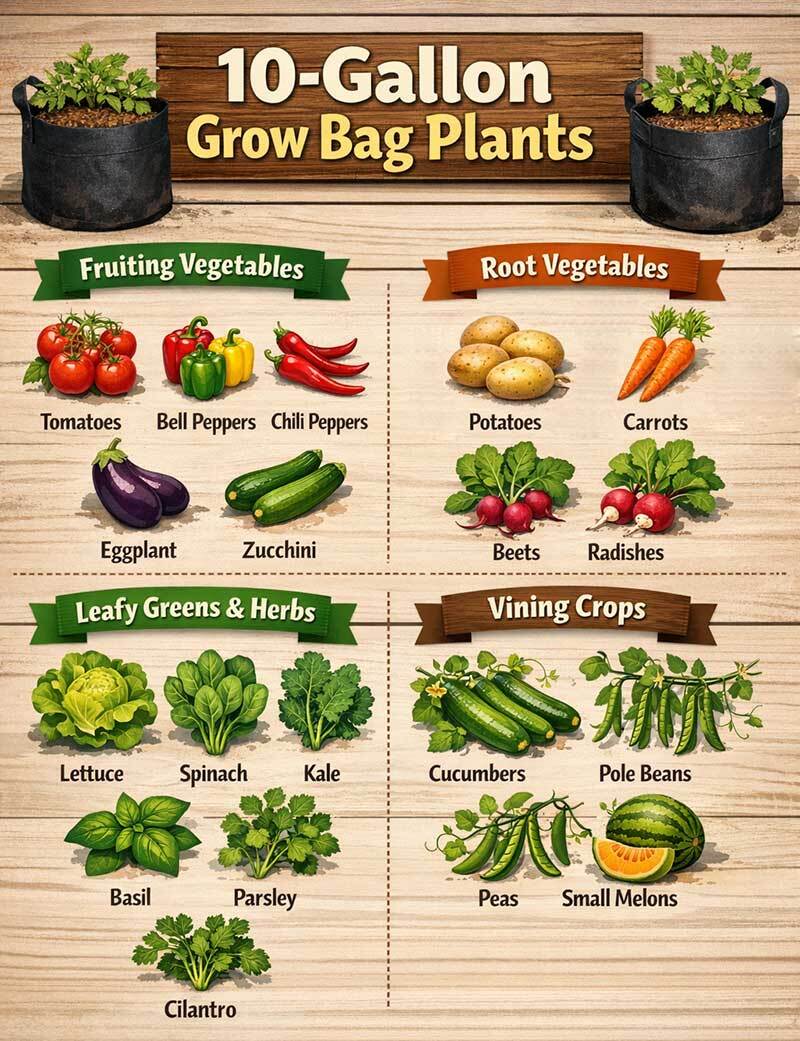
Leafy Greens & Herbs
Great for maximizing space with multiple plants.
✅ Lettuce.
✅ Spinach.
✅ Kale.
✅ Basil.
✅ Parsley.
✅ Cilantro.
These crops are ideal for continuous harvesting throughout the season.
Recommended Planting Density:
✔️ Lettuce: 4–6 plants per bag.
✔️ Spinach: 6–8 plants per bag.
✔️ Kale: 2–3 plants per bag.
✔️ Herbs: 4–8 plants per bag.
Growing Tips:
✅ Harvest outer leaves regularly for continuous production.
✅ Use mulch to reduce evaporation during hot weather.
✅ Succession plant leafy greens for longer harvest periods.
Vining Crops (With Support)
Vining crops can perform surprisingly well in 10 gallon grow bags.
✅ Cucumbers.
✅ Pole beans.
✅ Peas.
✅ Small melons (with strong support).
Vertical growing helps improve airflow and space efficiency in smaller gardens.
Recommended Planting Density:
✔️ Cucumbers: 1–2 plants per bag.
✔️ Pole beans: 4–6 plants per bag.
✔️ Peas: 6–8 plants per bag.
✔️ Small melons: 1 plant per bag.
Growing Tips:
✅ Use trellises or cages for climbing crops.
✅ Choose compact or bush varieties for limited spaces.
✅ Water consistently because vining crops consume moisture quickly.
How Many Plants Per 10 Gallon Grow Bag?
👉 Swipe the table left/right to view all plant details.
| Plant Type | Plants per 10 Gallon Grow Bag |
|---|
| Tomatoes | 1 plant |
| Peppers | 2–3 plants |
| Cucumbers | 1–2 plants |
| Potatoes | 3–5 seed potatoes |
| Lettuce | 4–6 plants |
| Herbs | 4–8 plants |
| Carrots | 20–30 plants |
| Radishes | 15–20 plants |
|
Can You Grow Tomatoes in a 10 Gallon Grow Bag?
Yes, tomatoes are one of the best crops for 10 gallon fabric grow bags.
Recommended Setup:
✔️ 1 tomato plant per bag.
Compact indeterminate or determinate varieties are usually the easiest to manage in container systems.
Tomato Growing Tips:
✅ Use stakes or cages for support.
✅ Water consistently because tomatoes dislike fluctuating moisture levels.
✅ Feed regularly during flowering and fruit development..
With proper care, 10 gallon grow bags can produce excellent tomato yields in small spaces.
How Many Potatoes in a 10 Gallon Grow Bag?
You can plant 3–5 seed potatoes per 10 gallon grow bag.
Potato Growing Tips:
✔️ Start with 4–6 inches of soil.
✔️ Add soil (hilling) as plants grow.
✔️ Stop when the bag is full.
Yield: typically 10–20 lbs per bag. This depends on variety and care.
How Many Cucumber Plants in a 10 Gallon Grow Bag?
You can grow 1–2 cucumber plants per bag.
Best practice:
✔️ Use a vertical trellis.
✔️ Choose compact or bush varieties for container growing.
✔️ Keep soil consistently moist.
What to Plant in 10 Gallon Grow Bags (Best Strategy)
To get the most out of each bag:
✔️ Grow one large crop per bag.
✔️ Combine several smaller plants carefully.
Companion Planting Ideas:
✅ Tomato + basil.
✅ Pepper + parsley.
✅ Kale + cilantro.
Shallow-rooted herbs can help improve space efficiency without creating severe root competition.
Rotating crops seasonally can also improve soil health and reduce pest pressure in container gardens.
Soil, Watering & Fertilizing Tips
How Much Soil for a 10 Gallon Fabric Pot?
✅ A 10 gallon grow bag requires about 1.3 to 1.5 cubic feet of potting soil (roughly 50–60 quarts).
✅ Use a light, well-draining potting mix.
Watering Tips
10 gallon grow bags dry faster than in-ground beds, especially during hot weather.
✅ Water approximately 2–4 times per week depending on climate.
✅ Check moisture regularly during summer heat.
✅ Add mulch to reduce evaporation.
Drip irrigation systems can help maintain consistent moisture in greenhouse and multi-container setups.
Fertilizing Tips
Fabric pots drain efficiently. Nutrients can leach out more quickly than in-ground soil.
✅ Add compost before planting.
✅ Use balanced liquid fertilizer every 1–2 weeks.
✅ Heavy-feeding crops benefit from additional feeding during fruiting stages.
Common Mistakes to Avoid
✅ Overcrowding plants.
✅ Using heavy garden soil (poor drainage).
✅ Inconsistent watering.
✅ Skipping support for vining crops.
✅ Under-fertilizing heavy feeders like tomatoes.
Conclusion
If you want to know what I can grow in 10 gallon grow bags? The answer is almost any medium-sized crop: from tomatoes and potatoes to cucumbers and herbs. With the right spacing and care, 10 gallon grow bags can deliver high yields and healthy root systems.
Check What to Grow in Grow Bags for a complete crop list across all grow bag capacities.
Related Guides:
What to Grow in 7 Gallon Grow Bags
What Can You Grow in 15 Gallon Grow Bags