What to Grow in Grow Bags: The Complete 1–400 Gallon Size Guide
Introduction
These fabric grow bags are also called fabric pots. Available in sizes from compact 1-gallon bags to massive 400-gallon containers. Ideal for home gardeners, greenhouse growers, nurseries, and farms.
Grow bags can support everything from herbs and leafy greens to fruit trees and commercial-scale crops. Different plants require different root space, soil volume, and moisture capacity. So choosing the right grow bag size is important.
You will learn what you can grow in grow bags. This complete guide will help you choose the right grow bag size for crops.
Why Grow Bags Are Ideal for Growing Plants?
Before choosing what to grow in fabric pots, it helps to understand why they work so well.
✔️ Excellent aeration for stronger root systems.
✔️ Air pruning prevents root circling.
✔️ Better drainage than plastic pots.
✔️ Portable and space-efficient.
These fabric pots can support nearly every type of crop when matched with the correct size. Suitable for small and large-scale growing.
What to Grow in Small Grow Bags (1–3 Gallons)
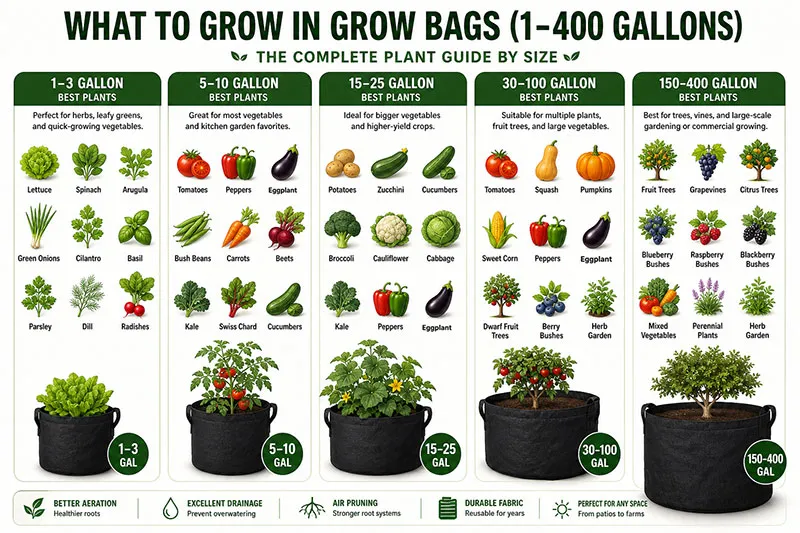
Small grow bags are best for compact plants with shallow root systems. These sizes are widely used for herbs, leafy greens, seed starting, and nursery propagation.
Best Plants for 1–3 Gallon Grow Bags
✅ Lettuce.
✅ Spinach.
✅ Arugula.
✅ Green onions.
✅ Basil.
✅ Cilantro.
✅ Parsley.
✅ Radishes.
✅ Small flowers and companion plants.
These crops grow quickly and do not require deep soil volume.
Small grow bags are especially popular for:
✔️ Balcony gardening.
✔️ Indoor growing.
✔️ Herb production.
✔️ Greenhouse seedling systems.
✔️ Retail nursery starter plants.
Growing Tips
✅ Water more frequently because smaller bags dry out faster.
✅ Use lightweight, high-quality potting mix for better drainage.
✅ Plant densely for cut-and-come-again greens and herbs.
✅ Place in partial shade during extreme summer heat.
Related Guides
What to Grow in 1-2 Gallon Grow Bags
What to Grow in 3 Gallon Grow Bags
What to Grow in Medium Grow Bags (5–10 Gallons)
The 5–10 gallon range is the most versatile size category for home gardeners. These grow bags provide enough root space for many productive vegetable crops. They are also easy to move and maintain.
They are also commonly used by greenhouse growers and small-scale market farms for high-value crops. If you’re asking what to plant in grow bags, this size covers the widest variety.
Best Plants for 5–10 Gallon Grow Bags
✅ Tomatoes (determinate and indeterminate).
✅ Bell peppers and chili peppers.
✅ Eggplant.
✅ Bush beans.
✅ Carrots.
✅ Beets.
✅ Kale.
✅ Swiss chard.
✅ Cucumbers (compact varieties).
Why This Size Range Is Popular
5–10 gallon grow bags offer:
✔️ Good root depth.
✔️ Stable moisture retention.
✔️ High productivity in small spaces.
✔️ Easy patio and backyard management.
This size range is commonly used for:
✔️ Patio vegetable gardens.
✔️ Raised-bed alternatives.
✔️ Greenhouse tomato production.
✔️ Small commercial container gardens.
Growing Tips
✅ Use cages or stakes for tomatoes and peppers.
✅ Grow one large crop per bag for best airflow and yield.
✅ Add compost regularly during the growing season.
✅ Use drip irrigation for greenhouse or multi-container setups.
Related Guides
What to Grow in 5 Gallon Grow Bags
What to Grow in 7 Gallon Grow Bags
What to Grow in 10 Gallon Grow Bags
What to Grow in Large Grow Bags (15–25 Gallons)
Large grow bags support larger root systems, heavier-feeding crops, and higher overall yields. These sizes are excellent for gardeners who want more production from fewer containers. They are also commonly used in nursery growing and intensive backyard food production.
Best Plants for 15–25 Gallon Grow Bags
✅ Potatoes.
✅ Zucchini.
✅ Cucumbers.
✅ Broccoli.
✅ Cauliflower.
✅ Dwarf blueberry bushes.
✅ Dwarf citrus trees.
✅ Large pepper plants.
Why Growers Choose This Size
15–25 gallon grow bags provide:
✔️ Better moisture stability.
✔️ More nutrient capacity.
✔️ Stronger root development.
✔️ Higher seasonal yield potential.
These sizes are ideal for:
✔️ Backyard food gardens.
✔️ Greenhouse vegetable systems.
✔️ Nursery container growing.
✔️ Compact fruit production.
Growing Tips
✅ Add mulch to reduce moisture loss.
✅ Space plants properly to improve airflow.
✅ Feed regularly because larger plants consume nutrients quickly.
✅ Rotate crops between seasons to maintain healthy soil.
Related Guides
What to Grow in 15 Gallon Grow Bags
What to Grow in 20 Gallon Grow Bags
What to Grow in 25 Gallon Grow Bags
What to Grow in Extra-Large Grow Bags (30–100 Gallons)
At this size range, grow bags function similarly to raised beds. They can support multiple plants in a single container.
These large fabric pots are increasingly used in:
✔️ Greenhouse systems.
✔️ Market gardens.
✔️ Nursery yards.
✔️ Urban farming projects.
Best Plants for 30–100 Gallon Grow Bags
✅ Multiple tomato plants.
✅ Squash and pumpkins.
✅ Sweet corn.
✅ Watermelons.
✅ Large herb gardens.
✅ Dwarf and semi-dwarf fruit trees.
✅ Companion planting combinations.
Popular Growing Combinations
✔️ Tomatoes + basil.
✔️ Cucumbers + dill.
✔️ Peppers + onions.
✔️ Corn + beans + squash.
Growing Tips
✅ Treat large grow bags like mini raised beds.
✅ Install drip irrigation for consistent watering.
✅ Use nutrient-rich soil blends with compost and perlite.
✅ Place in full sunlight for maximum production.
Related Guides:
What to Grow in 30–100 Gallon Grow Bags
What to Grow in Giant Grow Bags (150–400 Gallons)
Giant grow bags are built for large-scale growing systems and long-term crops. These oversized containers are widely used for commercial growing, greenhouse projects, orchards, and landscape applications.
Best Plants for 150–400 Gallon Grow Bags
✅ Full-size fruit trees.
✅ Grapevines.
✅ Large berry patches.
✅ Perennial crops.
✅ Mixed vegetable beds.
✅ Orchard container systems.
✅ Landscape shrubs and decorative plants.
Common Commercial Applications
Large grow bags are frequently used for:
✔️ Greenhouse tree production.
✔️ Nursery stock growing.
✔️ Vineyard container systems.
✔️ Urban landscaping projects.
✔️ Commercial fruit production.
Growing Tips
✅ Position bags before filling because they become extremely heavy.
✅ Install irrigation systems for efficient watering.
✅ Use premium soil blends with long-term fertility.
✅ Monitor drainage carefully in permanent growing setups.
Related Guides
What to Grow in 150–400 Gallon Grow Bags
Quick Reference: Best Plants by Grow Bag Size
👉 Swipe the table left/right to view all size details.
| Grow Bag Size | What to Grow |
|---|
| 1–3 Gallon | Herbs, leafy greens, radishes |
| 5–10 Gallon | Tomatoes, peppers, carrots, kale |
| 15–25 Gallon | Potatoes, cucumbers, zucchini |
| 30–100 Gallon | Corn, squash, fruit trees |
| 150–400 Gallon | Trees, vines, mixed crops |
|
Tips for Choosing the Right Plants for Grow Bags
Match Root Depth to Container Size
Deep-rooted plants need larger containers to reach full production potential.
Avoid Overcrowding
Too many plants in one grow bag can reduce airflow. This increases disease pressure, and lower yields.
Use a High-Quality Soil Mix
A balanced mix of: compost, coco coir or peat moss, perlite. It helps improve drainage, aeration, and nutrient retention.
Water Consistently
Fabric pots dry faster than plastic containers, especially in: hot climates, greenhouses, commercial growing environments.
Feed Plants Regularly
Nutrients leach more quickly from grow bags due to improved drainage. So regular fertilization is important for healthy growth.
Quick Reference: Grow Bag Soil Volume Chart
👉 Swipe the table left/right to view all size details.
| Grow Bag Size | Soil Needed (Cubic Feet) | Approx. Quarts) |
|---|
| 1–2 Gallon | 0.15 – 0.30 cu ft | 5 – 10 qt |
| 3 Gallon | ~0.4 cu ft | ~15 qt |
| 5 Gallon | ~0.7 cu ft | ~25–28 qt |
| 7 Gallon | ~1.0 cu ft | ~35–40 qt |
| 10 Gallon | ~1.3 – 1.5 cu ft | ~50–60 qt |
| 15 Gallon | ~2.0 cu ft | ~75 qt |
| 20 Gallon | ~2.5 – 3.0 cu ft | ~95–110 qt |
| 25 Gallon | ~3.5 cu ft | ~130 qt |
| 30–100 Gallon | ~4 – 13+ cu ft | ~150 – 500 qt |
| 150–400 Gallon | ~20 – 54+ cu ft | ~750 – 2000 qt |
|
For best results, fill grow bags to approximately 90–95% of total capacity. Leave 1–2 inches of space at the top for watering and airflow.
Conclusion
So, what can you grow in grow bags? The answer is almost anything when you choose the correct size. From herbs and leafy greens to tomatoes, potatoes, fruit trees, and commercial crops.
Fabric grow bags provide a flexible and efficient growing solution for nearly every gardening style. Select the right grow bag size will help improve plant health, root development, and overall yield.
FAQ
What can you grow in fabric pots?
You can grow vegetables, herbs, fruits, flowers, and even trees in fabric grow bags. The ideal plant depends on the grow bag size and root depth requirements.
What is the best size grow bag for vegetables?
5–10 gallon grow bags are ideal for many vegetables. For example, tomatoes, peppers, eggplants, and leafy greens.
Can you grow root vegetables in grow bags?
Yes. Root crops grow very well in fabric pots. For example, carrots, potatoes, radishes, and beets.
Do grow bags dry out faster than plastic pots?
Yes. Fabric grow bags provide better aeration and drainage than traditional pots. They usually require more frequent watering, especially in hot weather or greenhouse environments.
Are grow bags suitable for commercial growing?
Yes. Large grow bags are widely used in greenhouses, nurseries, orchards, and commercial container farming.