What to Grow in 20 Gallon Grow Bags: A Practical Guide
Introduction
20 gallon grow bags are one of the best container sizes for growing large vegetables, root crops, and high-yield plants. Ideal for home gardeners, greenhouse growers, and farms for productive container growing. In this guide, you’ll learn what plants thrive in 20 gallon grow bags.
Why Choose 20 Gallon Grow Bags?
A 20 gallon grow bag offers an excellent balance between root space and space efficiency.
✔️ Supports deep-rooted crops.
✔️ Better moisture retention than smaller grow bags.
✔️ Excellent drainage and root aeration.
✔️ Reduces risk of root circling through air pruning.
✔️ Suitable for patios, greenhouses, raised-bed alternatives, and small growing systems.
✔️ Reusable for multiple growing seasons.
Large fabric pots are especially popular for high-yield vegetables.
What Can You Grow in 20 Gallon Grow Bags?
20 gallon fabric pots can support a wide variety of vegetables, herbs, root crops, and vining plants.
Fruiting Vegetables
Fruiting crops are some of the best performers in 20 gallon grow bags.
✅ Tomatoes.
✅ Bell peppers.
✅ Chili peppers.
✅ Eggplant.
✅ Cucumbers (with trellis support).
20-gallon fabric pots improve drainage and airflow. This helps maintain healthier root systems.
20 gallon grow bags are commonly used for:
✔️ Patio vegetable gardens.
✔️ Greenhouse tomato production.
✔️ Intensive container gardening.
✔️ Backyard food growing systems.
Recommended Planting Density:
✅ Tomatoes: 1–2 plants per bag.
✅ Peppers: 2–3 plants per bag.
✅ Eggplant: 1–2 plants per bag.
✅ Cucumbers: 2 plants with trellis.
Growing Tips:
✔️ Use tomato cages or stakes for vertical support.
✔️ Place bags in full sun for maximum fruit production.
✔️ Remove lower leaves to improve airflow and reduce disease risk.
✔️ Feed regularly during flowering and fruiting stages.
Root Vegetables
Loose soil in fabric grow bags helps roots develop straight and healthy.
✅ Potatoes.
✅ Carrots.
✅ Onions.
✅ Beets.
Fabric pots improve drainage and make harvesting easier.
Recommended Planting Density:
✔️ Potatoes: 4–6 seed potatoes per bag.
✔️ Carrots: 30–40 plants per bag.
✔️ Onions: 8–12 plants per bag.
✔️ Beets: 10–12 plants per bag.
Growing Tips:
✅ Use loose, well-draining potting mix.
✅ Keep soil consistently moist during root development.
✅ Hill potatoes gradually to encourage additional tuber growth.
✅ Avoid overcrowding for larger root size and healthier plants.
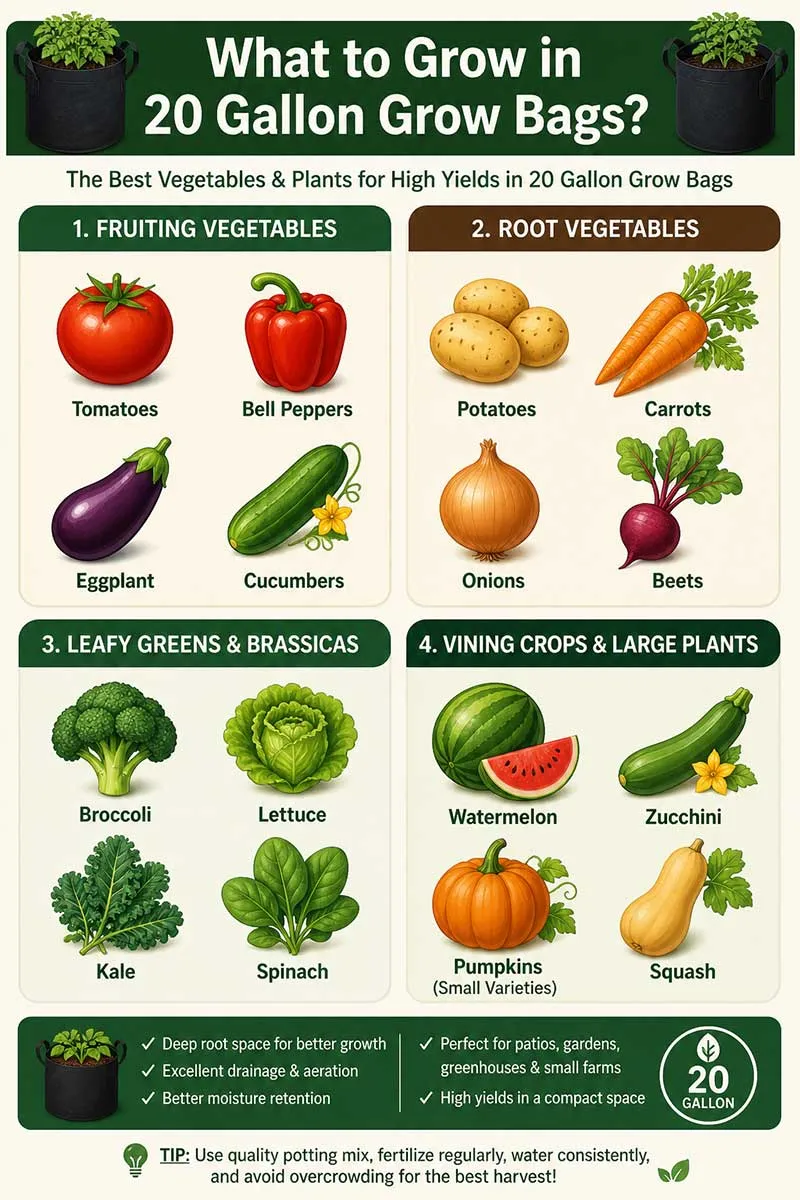
Leafy Greens & Brassicas
20 gallon grow bags can support multiple leafy crops in a single container.
✅ Broccoli.
✅ Lettuce.
✅ Kale.
✅ Spinach.
✅ Swiss chard.
These crops benefit from the cooler, more stable moisture conditions.
Recommended Planting Density:
✔️ Broccoli: 2–3 plants per bag.
✔️ Lettuce: 6–8 plants per bag.
✔️ Kale: 2–3 plants per bag.
✔️ Spinach: 8–10 plants per bag.
Growing Tips:
✅ Harvest leafy greens regularly for continuous growth.
✅ Use mulch to retain moisture and reduce temperature swings.
✅ Provide partial afternoon shade in extremely hot climates.
Vining Crops & Large Plants
Larger grow bags can support spreading and vining crops when paired with proper spacing and support systems.
✅ Watermelon (compact varieties).
✅ Zucchini.
✅ Squash.
✅ Small pumpkins.
These crops require: large root zones, consistent watering, strong sunlight, good airflow.
Recommended Planting Density:
✔️ Watermelon: 1 plant per bag.
✔️ Zucchini: 1 plant per bag.
✔️ Squash: 1 plant per bag.
✔️ Small pumpkins: 1 plant per bag.
Growing Tips:
✅ Use vertical supports whenever possible to save space.
✅ Avoid overcrowding to reduce disease pressure.
✅ Water deeply during flowering and fruit development.
How Many Plants per 20 Gallon Grow Bag?
This is where most growers make mistakes: overcrowding reduces yield.
👉 Swipe the table left/right to view all plant details.
| Plant Type | Plants per 20 Gallon Grow Bag |
|---|
| Tomatoes | 1–2 plants |
| Potatoes | 4–6 seed potatoes |
| Cucumbers | 2 plants (with trellis) |
| Peppers | 2–3 plants |
| Watermelon | 1 plant |
| Onions | 8–12 plants |
| Broccoli | 2–3 plants |
|
Detailed Planting Answers
How many potatoes in a 20 gallon grow bag?
You can plant 4–6 seed potatoes. Hill the soil as they grow to increase yield.
How many tomato plants in a 20 gallon grow bag?
1 plant (recommended for maximum yield).
Up to 2 plants if properly fertilized and pruned.
How many cucumber plants per 20 gallon grow bag?
Plant 2 cucumber plants with a vertical trellis for best results.
How many pepper plants in a 20 gallon grow bag?
You can grow 2–3 pepper plants, depending on variety size.
How many watermelon plants per 20 gallon grow bag?
Only 1 watermelon plant per bag. Choose compact or dwarf varieties.
How many onions in a 20 gallon grow bag?
You can grow 8–12 onions, spaced evenly across the surface.
How many broccoli plants per 20 gallon grow bag?
Plant 2–3 broccoli plants to allow proper head development.
Soil, Watering & Fertilizing Tips
How Much Soil for a 20 Gallon Grow Bag?
✅ A 20 gallon grow bag requires approximately 2.5 to 3 cubic feet of soil.
✅ Avoid using heavy garden soil because it can reduce drainage and aeration.
Watering Tips
✅ Water deeply 1–3 times per week depending on weather.
✅ Check soil moisture regularly during hot summer conditions.
✅ Add mulch to reduce evaporation.
Drip irrigation systems are useful for greenhouse setups and larger container gardens.
Fertilizing Tips
✅ Apply slow-release fertilizer at planting time.
✅ Supplement with liquid fertilizer during peak growth.
✅ Heavy-feeding crops benefit from regular compost additions.
Tips for Higher Yields
Use Vertical Support Systems
Stakes and trellises improve:
✔️ Airflow.
✔️ Space efficiency.
✔️ Fruit quality.
✔️ Harvest access.
Avoid Overcrowding
Larger spacing usually produces:
✔️ Bigger harvests.
✔️ Healthier roots.
✔️ Better airflow.
✔️ Reduce disease risk.
Rotate Crops Between Seasons
Crop rotation helps reduce:
✔️ Soil-borne diseases.
✔️ Nutrient depletion.
✔️ Pest buildup.
This practice is commonly used in both home gardens and intensive container growing systems.
Conclusion
So, what to plant in 20 gallon grow bags? The answer is tomatoes, potatoes, cucumbers, or leafy greens etc. 20-gallon fabric pots can deliver high yields in a small space. The key is choosing the right crops and spacing them properly.
For a complete overview of all grow bag sizes, check:
What to Grow in Grow Bags
Related Guides:
What to Grow in 15 Gallon Grow Bags
What Can You Grow in 25 Gallon Grow Bags